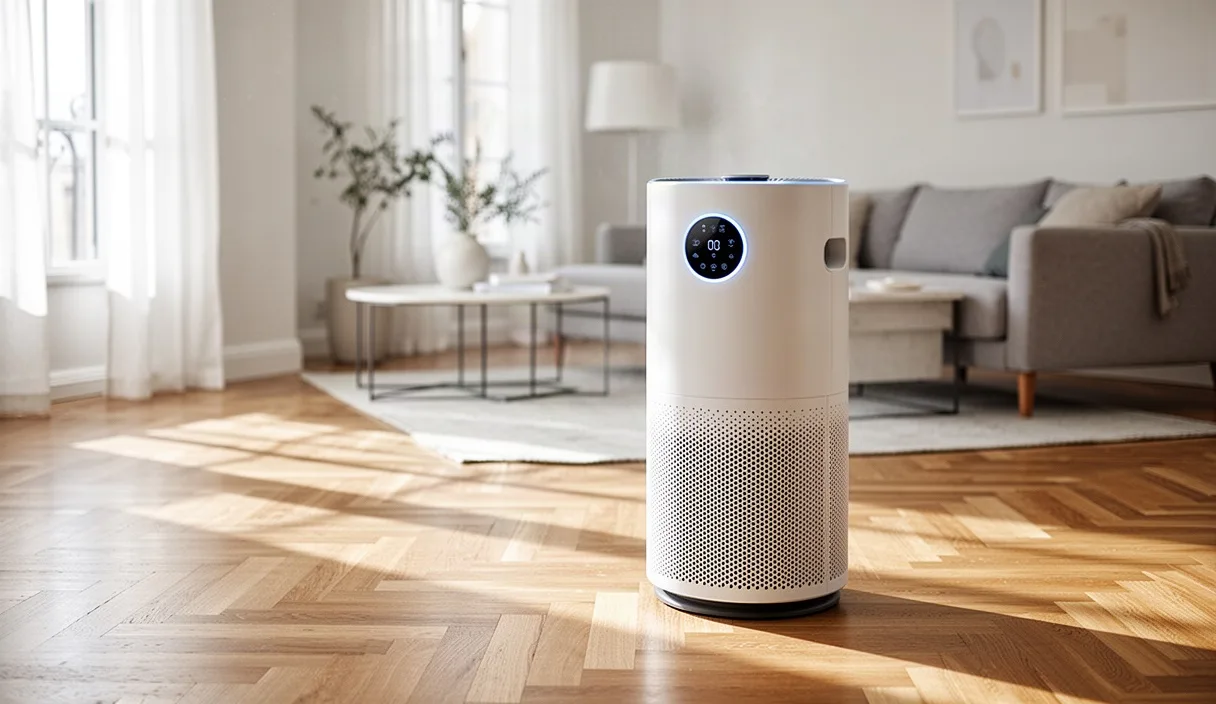
Living rooms present a complex air quality profile because they host diverse domestic activities within a single shared space. Soft furnishings such as couches, area rugs, and drapes shed micro-fibers and trap pet dander, while human traffic continually resuspends settled dust into the breathing zone. At the same time, living spaces often connect directly to open-plan kitchens, front entryways, and attached garages, allowing cooking emissions, vehicle exhaust, and street dust to merge with volatile compounds released by floor finishes and pressed-wood furniture.
Homeowners seeking to manage these airborne contaminants often conflate mechanical particulate filters with sorbent chemical media. Installing the wrong technology leaves specific pollutant categories unaddressed, resulting in persistent chemical smells or lingering sub-micron particles despite continuous air circulation. Achieving measurable improvements requires an understanding of how High-Efficiency Particulate Air (HEPA) media and activated carbon operate on a physical and chemical level, alongside realistic calculations of living room dimensions and air exchange rates.
Mechanisms of Particulate Trapping in True HEPA Media
A True HEPA filter consists of a dense mat of randomly arranged borosilicate glass fibers, ranging in diameter from 0.5 to 2.0 micrometers. Unlike kitchen sieves or screen doors, HEPA media does not function as a simple two-dimensional mesh that catches particles larger than the holes. Instead, it relies on a tortuous three-dimensional path where four distinct physical mechanisms trap particles as air flows through the pleated sheet.
The primary mechanisms depend directly on the size and velocity of the incoming particulates:
- Sieving: Occurs when a particle is simply too large to pass between the physical clearance of two adjacent fibers. This mechanism captures larger debris such as coarse textile lint, hair, and heavy pollen grains above 10 micrometers.
- Inertial Impaction: Larger, heavier particles possess too much forward momentum to follow the curved streamlines of airflow around a glass fiber. As the air diverts, the particle travels straight ahead and collides directly with the fiber surface, adhering through electrostatic attraction. This mechanism primarily targets dust, pet dander fragments, and mold spores between 1.0 and 10 micrometers.
- Interception: Medium-sized particles navigate along the air streamlines but pass within one particle radius of a fiber. When the edge of the particle touches the fiber, it becomes captured. This affects fine dust, cooking oil droplets, and larger bacteria measuring between 0.4 and 1.0 micrometers.
- Diffusion: Sub-micron particles do not follow smooth streamlines. Instead, collisions with gas molecules cause them to move in an erratic zigzag pattern known as Brownian motion. This random trajectory substantially increases the likelihood that a particle strikes a fiber, regardless of whether the fiber lies directly in the gross airflow path. Diffusion dominates for smoke particles, condensed vapors, and virus carriers smaller than 0.3 micrometers.
The intersection of interception and diffusion creates the Most Penetrating Particle Size (MPPS), which occurs around 0.3 micrometers. Particles at this threshold are too large to diffuse aggressively via Brownian motion, yet too small to possess sufficient inertia for straight-line impaction. The standardized True HEPA benchmark, codified in DOE-STD-3020-2015, requires that the media retain 99.97% of particulates at this exact 0.3 micrometer MPPS. Because diffusion and impaction operate with higher capture rates on either side of the MPPS, particles measuring 0.1 micrometer or 2.5 micrometers are captured with efficiencies exceeding the 99.97% baseline.
Adsorption Principles of Activated Carbon Granules
Activated carbon operates via surface chemistry rather than physical filtration. It relies on adsorption: a physical process where gas-phase molecules adhere to the internal surfaces of a solid, distinct from absorption where a substance permeates into the bulk volume of a liquid or solid. Raw carbonaceous materials such as coconut shells, bituminous coal, or wood undergo thermal activation with steam at temperatures between 800 and 1000 degrees Celsius. This oxidation process erodes internal pathways, yielding a porous network with an internal surface area between 950 and 1400 square meters per gram.
When gaseous pollutants drift through an activated carbon bed, non-polar compounds are drawn to the carbon walls by weak intermolecular forces known as London dispersion forces, a subset of van der Waals interactions. The effectiveness of this capture depends heavily on the boiling point and molecular weight of the gas. Volatile organic compounds (VOCs) with molecular weights above 45 grams per mole, such as benzene, toluene, and xylene from paints and adhesives, condense readily within the micro-pores of the carbon bed.
Standard activated carbon struggles with low-molecular-weight gases such as formaldehyde, ammonia, and sulfur dioxide because their small size and high volatility allow them to slip through standard pores without settling. To address these living room hazards, manufacturers impregnate the carbon with chemical reagents like potassium permanganate, copper sulfate, or phosphoric acid. The impregnated chemicals trigger a process called chemisorption, where the contaminant reacts chemically with the impregnate to form an inert, stable salt bound permanently to the media.
Because carbon features no structural capacity to catch airborne solids, running dusty air through an unprotected carbon bed rapidly covers its micro-pores with fine lint, rendering the adsorption sites unreachable for gaseous chemicals. Conversely, True HEPA fiberglass structures possess zero molecular affinity for vaporous compounds. Gasoline exhaust vapors, off-gassing flame retardants from synthetic rugs, and cooking smells pass directly through HEPA pleats without resistance.
Assessing Your Primary Pollutant: Particulates or VOCs
Determining the dominant air pollution challenge in your living room dictates the ratio of mechanical media to carbon adsorbent required in your equipment. Living rooms vary considerably based on building materials, family habits, and structural layout.
| Pollutant Category | Primary Filter Required | Common Living Room Sources | Target Scale |
|---|---|---|---|
| Particulates (Coarse) | Pre-filter / True HEPA | Dog dander, carpet fluff, plant pollen, tracked-in soil | 2.5 to 100 micrometers |
| Particulates (Fine/Ultrafine) | True HEPA | Candle soot, woodstove leakage, secondary cooking smoke | 0.01 to 2.5 micrometers |
| Volatile Organic Compounds | Granular Activated Carbon | New sofa foam, carpet adhesive, fresh paint, wall vinyl | 0.3 to 1.5 nanometers |
| Inorganic Acid Gases | Impregnated Carbon | Gas water heater backdrafts, outdoor traffic fumes | 0.2 to 0.6 nanometers |
If your household suffers from morning sneezing, visible dust trails in sunlight, or recurring shedding from multiple pets, the primary objective is particulate reduction. In these conditions, mechanical True HEPA with high volumetric airflow must take operational precedence. However, if your home features newly installed engineered wood flooring, fresh upholstery coated with stain-repellent chemicals, or an attached garage where solvent odors seep through the threshold, gas-phase VOCs are the primary hazard, requiring substantial carbon mass.
For complex exposure scenarios involving respiratory conditions like severe asthma, consulting a licensed indoor environmental consultant or an occupational hygienist is recommended to run formal multi-gas logging before investing in industrial-grade purification setups.
Clean Air Delivery Rate and Room Volume Calculation
Air cleaners are evaluated using the Clean Air Delivery Rate (CADR), established under ANSI/AHAM AC-1 testing standards. CADR reflects the cubic feet per minute (CFM) of clean air delivered, devoid of a specific particulate fraction. The Association of Home Appliance Manufacturers measures three distinct particulate sizes: smoke (0.09 to 1.0 micrometer), dust (0.5 to 3.0 micrometers), and pollen (5.0 to 11 micrometers). CADR metrics apply exclusively to particulate removal and do not score gaseous pollutant clearance.
To determine the minimum CADR required for an enclosed living room, you must calculate the total air volume and select a target for Air Changes per Hour (ACH). For general household air maintenance, 3 ACH is typical, while allergy or smoke mitigation plans require at least 4.5 ACH.
Calculate the living room floor dimensions: Measure length and width in feet. For an example living room measuring 22 feet by 16 feet, the floor area is 352 square feet.
Calculate internal volume: Multiply floor area by ceiling height. If the room has 9-foot ceilings, the total cubic volume equals 3,168 cubic feet (352 multiplied by 9).
Determine total hourly air movement: Multiply the volume by the desired air changes. For 4.5 ACH, calculate 3,168 multiplied by 4.5, which equals 14,256 cubic feet per hour.
Convert to cubic feet per minute (CFM): Divide the hourly volume by 60 minutes. In this case, 14,256 divided by 60 equals 237.6 CFM. Therefore, the air cleaner must demonstrate a smoke CADR rating of at least 238 CFM to process that specific space adequately at high speed.
If your living room has wide, unsealed archways leading directly to a dining room or foyer, you must add the adjacent volume to the calculation. Running an air cleaner sized only for 3,168 cubic feet inside an open-plan layout of 7,000 cubic feet dilutes the clean air delivery, rendering the actual exchange rate lower than 2 ACH, which fails to suppress particulate accumulation.
Filter Replacement Timelines and Maintenance Signs
Mechanical HEPA media and activated carbon degrade according to entirely different physical patterns. Monitoring their service lives demands different diagnostic approaches.
True HEPA filters load progressively over time. As fibers collect dust, they create a secondary filter layer called a dust cake. Paradoxically, this dust cake slightly increases filtration efficiency for a brief period by narrowing interstitial paths. However, this accumulation causes a steady increase in static pressure drop across the media. The fan motor works harder against this resistance, resulting in reduced airflow volume and increased motor whine. In typical domestic settings, a True HEPA filter lasts between 10 and 14 months. Visual inspection provides clear evidence: when the media changes from crisp white to a dense, uniform dark slate gray, replacement is overdue.
Activated carbon does not experience measurable pressure drop as it saturates. Because gas adsorption happens on an atomic scale inside internal pores, a fully spent carbon bed presents the exact same airflow resistance as a brand-new one. When every available adsorption site is occupied, the filter reaches breakthrough. At this stage, the carbon bed can begin releasing previously trapped chemicals back into the room air, a process called desorption, particularly if room temperatures rise or relative humidity exceeds 65 percent.
A telltale indicator of saturated carbon is a distinct sour, vinegar-like, or sweet solvent odor radiating from the air outlet while the unit runs. Under average domestic VOC exposure, thin carbon filters saturate within 70 to 110 days, while deep-bed carbon canisters weighing between 3 and 7 pounds remain effective for 8 to 14 months. Vacuuming or setting a carbon filter in the sun will not reliably clear the micro-pores; once saturated, the core requires complete replacement.
Combining Both Technologies in a Single Household Unit
The most effective residential approach combines both technologies in a strict sequential layout. Air must pass through consecutive stages designed to protect subsequent media layers from premature contamination.
The primary barrier is a washable or vacuumable coarse pre-filter made from woven nylon or open-cell polyurethane foam. This catches visible hair, textile threads, and large dander (15 micrometers and above), ensuring the True HEPA pleats are not overwhelmed by coarse debris within the first few weeks of operation.
The secondary barrier is the deep-pleated True HEPA filter. This captures fine particles, soot, and sub-micron aerosols down to 0.3 micrometers. Placing the HEPA media ahead of the carbon protects the chemical sorbent from particulate fouling, reserving the carbon's internal surface area exclusively for gas-phase molecules.
The tertiary stage is the activated carbon bed. It adsorbs gases, cooking emissions, and airborne solvents that slipped cleanly through the earlier particulate stages. High-performing systems place heavy granular beds downstream of the HEPA. Placing loose granular carbon before the HEPA can cause shed carbon dust to blast into the living room, whereas placing it after the HEPA ensures that any fugitive carbon dust is either caught on a post-filter or remains trapped inside the chassis.
This multi-stage architecture introduces aerodynamic drag. Moving air through both a tightly woven fiberglass mat and several pounds of carbon granules requires a backward-curved centrifugal fan rather than a low-pressure axial blade. Consequently, combined units tend to pull between 42 and 85 watts on their highest operational settings, generating sound profiles ranging from 32 decibels on silent modes to 58 decibels at peak operational velocity.
Common Mistakes
- Relying on carbon-impregnated fiber sheets for chemical abatement: Many budget air cleaners feature a thin, porous black foam sheet labeled as a carbon filter. These sheets contain only 20 to 60 grams of carbon dust glued to synthetic fibers. They provide adequate particulate pre-filtration but saturate within two to four weeks of VOC exposure, offering no practical long-term gas management.
- Washing non-washable True HEPA filters: Rinsing a standard borosilicate HEPA filter under a faucet or spraying it with liquid soap breaks the electrostatic charge and collapses the microscopic glass fiber matrix. Even if dried thoroughly, the media develops tears and enlarged gaps, dropping particulate capture efficiency well below certified standards.
- Operating purifiers on minimum speed continuously: The CADR ratings stamped on air purifiers reflect performance at maximum fan velocity. Operating a unit exclusively on low speed drops the effective air delivery by roughly 60 to 75 percent, which rarely yields sufficient air changes to process a standard 300-square-foot living room.
- Placing units in corners or behind sofas: Tucking an air cleaner against a wall, behind drapes, or beside dense upholstery chokes the intake vents. Air purifiers require an unhindered clearance zone of at least 18 inches on all intake sides to establish functional convective loops across the entire room.
Practical Next Steps for Living Room Air Quality
To upgrade the air in your living space methodically, begin with an audit of physical square footage and layout constraints before purchasing hardware.
Map the target area: Walk the perimeter of your living room with a tape measure to record floor dimensions and ceiling height. Note openings to adjacent kitchens or stairwells that expand the total air envelope.
Identify primary irritation sources: If seasonal tree pollen, woodstove ash, or long-haired pets cause your primary air complaints, search for units with substantial HEPA surface area (measured in total square feet of pleated media) and a certified smoke CADR matching your room volume at 4 ACH.
Weigh the chemical load: If your concern centers on synthetic carpets, new paint, or strong cooking odors, prioritize units containing at least 3 to 10 pounds of actual granular activated carbon pellets rather than carbon-dusted synthetic sheets.
Establish a maintenance schedule: Upon installation, set calendar reminders for pre-filter vacuuming every 21 days, carbon core review every 6 months, and complete HEPA replacement annually. For households with complex respiratory conditions or serious indoor moisture issues, arrange for an inspection by an indoor air quality professional to resolve structural root causes alongside mechanical filtration.